Java Rice Finch

(Padda Oryzivora)

Common Names: Java Finch, Java Rice Finch, Java Temple Bird, Java Sparrow, Paddy Finch

Description: In the normal form the head, nape and chin are black with white cheek patches outlined in black. The primary flight wings feathers and upper tail converts are also black. A blue-gray covers the bird's mantle, back, secondary wings, chest and rump. The belly is a cinnamon brown color and the under tail coverts are white. Javas have red-pink beaks, legs and eye circles. Both sexes look identical with only slight differences in beak shape and color.

Size: These birds average 5-6 inches (13-15cm) and are very hardy birds.

Origin: Java Finches are also known as Java Rice Birds, Java Sparrows, Java Temple Birds and Java Paddy Finches. They originated from the islands of Java in Indonesia and have spread out through southern Asia, parts of Africa and Hawaii. At some time in the 1970's there was a ban placed on imprting Javas into the USA. Most Javas currently in the US are a domestic breed although some wild flocks have been established from released or escaped domestic birds. It is not evident at this time how the wild Javas in Hawaii first arrived but they are considered by some as agricultural pest.

Sexing Javas: Sexing a Java Finch is the hardest part of owning one. They can be very difficult to sex especially with young birds! There are four ways to distinguish the gender of Java Finches but only one has 100% accuracy so let's start there. ONLY the male Java Finch sings!! Young male birds will attempt to sing at about 1-2 months after they fledge. In order to hear the bird sing you can separate them from all other birds. If the bird in question is a male it will start to sing after about a week of solitude. If you have a flight full of Javas it will be easier to pick out males because they sing a lot more in a flight or you can try introducing a new Java into the flight to intice the males. The problem with spotting them in the flight is catching the same bird that was singing!! To solve this you can put a different color plastic band on all your Javas & when you hear one singing notice it's band color. You can write this down in your records, catch the birds up later and band all the hens one color and the males another. I chose to band all my males Red and females Purple. If you are unsure how to band birds or do not know where to get bird bands you can click on the following link for all the information -----> BIRD BANDING-CLICK THIS! Female Java's do make a clicking or whirring sound but they DO NOT sing! If you hear the slightest singing ...IT'S A MALE!

There are other ways to sex Javas such as beak sexing, eyering sexing, pelvis sexing & DNA sexing. When sexing by beak it is important to note that mature male Javas have a swollen area at the base of the beak & hens do not. The hen's beak seems longer and narrower in comparison while the male's beak is wider and has a blunt tip. Below are some really good photos taken from Rob Salem and myself which illustrate what I am trying to explain. After taking a look at the photos, the differences in the beaks become much more apparent and of course after time with a trained eye it is easier to pick out males. Just remember the base of a young male's beak is not near as swollen as a mature male's beak but it is still wider and blunter than the hens beak.

Beak Sexing

Side View:

Top View:

Under View:


Eyering Sexing

In the photos you can see the hens eyerings are more red because the male happens to be in a molt.

Most of the time male Java Finches will have wider & redder eyerings. I myself do not rely on this method to often as so many factors can vary the eyering color such as the condition of the bird, the diet, and age. Below are two photos taken by Rob Salem (www.javafinch.com) of Javas which show how eye ring color can fool you.

Pelvic & DNA Sexing

The fourth and hardest method of sexing Java Finches is by feeling of the pelvic region. The hens pelvic bones will move slightly and be further apart than the males. This is much harder to do in finches than in parrots because of the size difference. I would definitely not rely on this method alone because young hens which have never laid eggs before will have the same pelvic width as males. If your bird lays eggs well you already know it's a hen. Another option if you can not decide the gender of your Java Finch is DNA sexing which is 99% accurate but does cost around $15-20 a bird. This method is great for sexing hens which are the ones that can fool you!

Mutations/Sub-species: In domesticated breeds there are several known mutations. Further mutations are being created by combining these existing mutations. There have also been reports of various oddities such as Black headed Java Finches which normaly molt into normal colored Javas at maturity. Below is a chart of these mutations and genectic inheritence.

Java Finch Mutation Head Study

Java Finch Genetics Chart

Mutation
Genetic Inheritance
Dominant
Sex-Linked Recessive
Autosomal Recessive
Multiple Allemorph of Fawn
Autosomal Recessive

Agate

Sex-Linked Recessive
Autosomal Recessive
Autosomal Recessive


Combination Mutations
Genetic Inheritance
Silver x Fawn Combination
Dilute Silver x Dilute Fawn Combination
Dilute Normal x Fawn Combination
Dilute Normal x Silver Combination
White x Fawn Combination
Click on each Java Finch mutation to view photo!

Sub-Species

Timor Sparrow (Padda Fuscata) - Same pattern characteristics as Javas but a dull shade of brown.

Diet: A good Java Finch diet consist of Proso (white) millet, canary grass seed, hemp seed, oat groats & paddy rice. Budgie mix has most of this but you may have to add the paddy rice yourself. You can add red and yellow millet to the mixture but I find Javas normally neglect these smaller seeds. To condition our birds we coat the seed mixture with Wheat Germ Oil (1/2 tsp per pound of seed). It helps prevent egg binding and provides vitamins. Fresh water, cuttlebone, oyster shell and grit should be supplied at all times. We provide other supplements such as Petamine breeding formula (during breeding season) and Feather Up (while molting) in small treat cups. Lettuce, spinach, chickweed, peas, green beans, corn, spray millet, eggfood, soaked seed, broccoli tops and carrot tops can also be offered on a regular basis. Live food and pellets can be provided while rearing young but is not necessary. Be sure to wash all veggies before allowing birds to consume them!

General Care: These birds require routine nail trimming. Provide bath water daily to keep feathers sleek.

Compatibility: Java Finches can be kept together in same species aviaries, mixed-species aviaries or as single pairs. Be careful not to put them with smaller species that they can become aggressive towards. Also when housing in mixed species flights it is best not to have more than 1-2 pair otherwise they tend to dominate the flock. There can be slight bickering during breeding season with males housed together or when new birds are introduced but generally Javas are not aggressive birds.

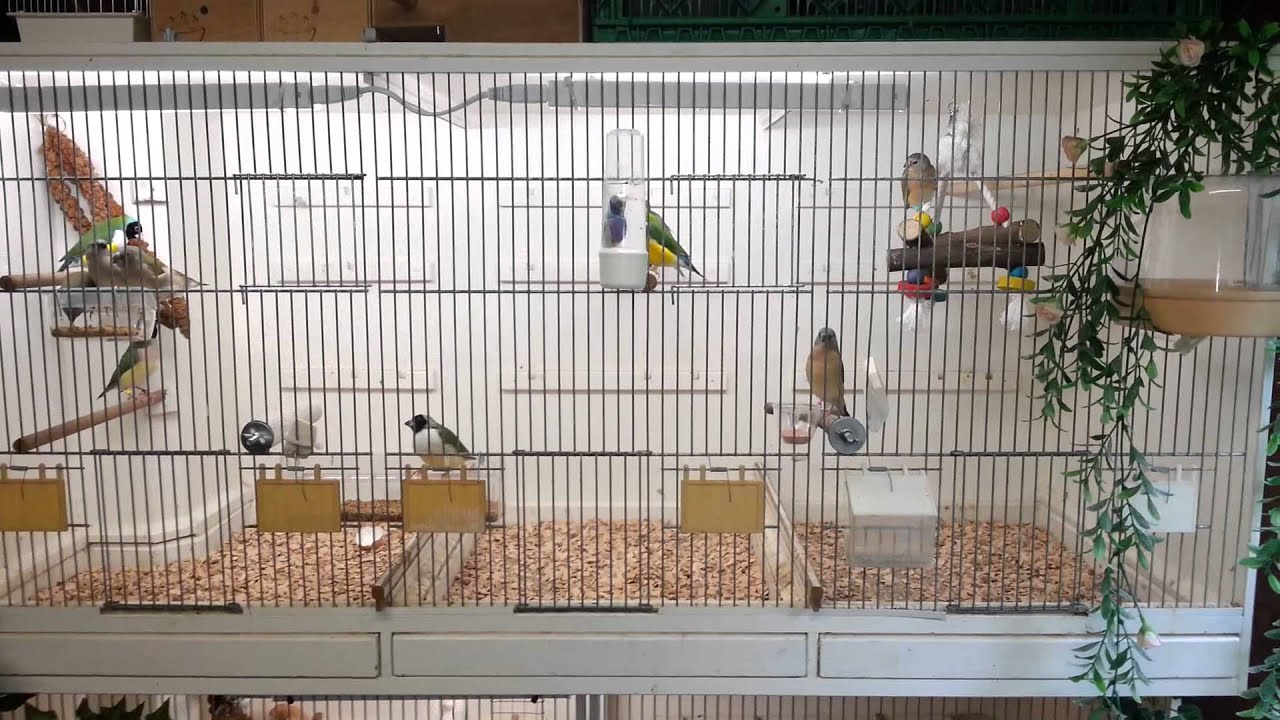
Housing: Many Javas are house in individual box breeding cages much like Canaries. However, they will thrive in a large planted aviary with plenty of room to fly, sing and socialize. Javas do not require a lot of heat during winter. They can tolerate low temperatures of 50 degrees if natualy aclimatized to it over a period of time but if they are suddenly removed for warmer temps and placed into cold climate they can become ill. If you intend to breed you would do better with an idividual pair set up as less dominant Java Finches seem to get easily distracted from breeding in colony settings. I would suggest a minimum breeding cage space of 24 inches long x 18 inches high x 18 inches wide with a 1/2 inch bar spacing if you use wire cages. Do not house them in round cages. We breed our Javas in tier-style box cages. They seem to enjoy the privacy of solid wall box breeder cages but we have bred them in wire cages with the same success. All our young weaned Javas are placed in a large flight cage to color up and exercise untill paired up the following year. Our pairs are also placed in large flights during summer to rest from breeding and molt.

Song: The male Java Finch has a delightful song which they start attempting around 3 months of age. Some males can be shy about singing around people if not accustom to thier presence. However, if they do not mind people around they have a loud repedative tune which reminds me of the sound of weapon fire on Star Wars. I have noticed that not all Javas sing the same. Our breeding flock of male White Javas sing louder than our other mutation males. This could possibly have to do with age and them being more accustom to us. Hens are not mute they do make clicking sounds like the male but they do not sing. Click the button below to hear male and female Javas.


Breeding: Established pairs of Java Finches make excellent parents. I have had pairs lay 8 eggs, hatch 8 eggs and take care of all 8 babies with no problems. I can not say this about my other finches Societies & Zebras included! Once you determine you have a pair and condition them for breeding you can give them access to a nest box. If you buy your nestbox from a petstore it would be best to go with the size built for parakeets. It measures 8in (long) x 6in (wide) x 6in (height) with a sliding partition on top to inspect for eggs. The hole in the box has a diameter of 2.5in. You can drill a small hole under the entrance & insert a portion of dowel rod for the birds to perch on. I do not have a perch inserted beneath the entrance hole because my nestboxes are installed outside the breeding cage vs. internaly to give the birds more flight room. The nestboxes are attached to the wire cage fronts by sliding wire ties through the small holes on the corners of the box and through the wire on the cage fronts then tightened with the excess wire tie strand cut off. I prefer them attached externaly because it makes them so much easier to inspect . A lot of people have asked me if it's ok to paint the nest box?...It would be fine to paint the outside of the box as long as you use non-toxic paint with no lead but I would advise not painting the inside of the box as it is possible it might distract your Javas from breeding. When you place a nestbox in the cage with your Java pair they should start building a nest in about 1-2 weeks provided you supply plenty of nesting material. It is important to provide nesting material because it craddles the eggs better & keeps the chicks warmer. Javas will lay eggs without nesting material but they will constantly be picking and pulling the paper on the cage floor untill they shred enough to place in the box. If you supply enough of the right materials from the start they will be content with thier nest & more able to care for their young properly. Javas prefer course grasses more than soft tissue-like nesting material.You can supply them with meadow grass, coconut fibers, shredded paper, bamboo leaves and siscal. Be sure you don't supply Dandelion grasses for nesting as they will build a nest with it then eat it later :) After breeding takes place the hen normaly lays 5-7 eggs which both parents take turns incubating for 14-18 days. After hatching it will be about 28-31 days before the young Javas leave the nest. It takes another 2-3 weeks before the young Javas are weaned and independent. It can take young Javas 3-5 months to molt into adult plumage.

For more precise info on breeding Java Finches please check out the sites below. The first is Rob Salem's website and the second belongs to Steve Nesbitt. Both these Java breeders are located in the UK.

Price List: Java Finches can be sexed if prior notice is given.

Mutation
Price Per Pair
$50.00 Pair
$60.00 Pair
$70.00 Pair
$60.00 Pair
$80.00 Pair
$100.00 Pair
$100.00 Pair
$400.00 Pair